Building a Custom AI Waifu Personality That Does Not Go Flat
- A trait list produces an agreeable blank. A contradiction produces a person
- Backstory beats adjectives: facts generate behaviour, labels do not
- Everything you write competes for room in a finite context, so shorter and sharper wins
- Two apps here have a real builder; the third gives you written characters instead
Most custom characters come out bland, and people conclude the model is weak. It usually is not. The character is bland because of what went into the builder, and the builder actively encourages the thing that causes it.
Why sliders make everything agreeable
A typical builder offers traits as independent dials: warm, playful, confident, caring, flirty. Turn them all up and you get a character who is warm, playful, confident, caring and flirty at once, in every situation, forever. That is not a personality. It is a customer service voice with a name on it.
Real characters read as real because their traits conflict. Confident about work and awkward about being complimented. Warm with you and short with everyone else. Playful right up until a specific subject, where she goes quiet. The interesting behaviour lives in the seam between two traits that do not fit together, and a slider interface has no way to express a seam.
Write the contradiction explicitly
Whatever the interface gives you — a free-text box, a backstory field, a personality summary — that is where the character actually gets made. Put the tension there in plain language: she is direct about everything except how she feels, she jokes when a conversation gets serious, she is generous with time and stingy with details about her family.
Each of those generates behaviour across a hundred different situations, which a trait label does not. "Funny" tells the model to be funny. "Jokes when a conversation gets serious" tells it when, which is the part that makes a character feel like it has a shape.
Facts beat adjectives
- Give her a job, and make it specific. "Night-shift radiographer" produces schedule, tiredness, and things to complain about; "medical" produces nothing.
- Give her one thing she is unreasonable about. Unreasonableness is memorable and produces reliable friction.
- Give her a relationship with someone who is not you. A sister she argues with is worth more than three adjectives.
- Give her something she wants that has nothing to do with you. It is the difference between a character and a service.
- Give her a way of speaking, not a tone. "Uses your name when she is annoyed" is a behaviour; "sarcastic" is a hope.
Every one of those is a fact the model can act on. The reason it works is mechanical rather than artistic: the definition is text competing with everything else in a finite window, and concrete text produces specific behaviour while abstract text gets averaged away. The same mechanics that make long scenes drift are described in the roleplay guide.
Shorter is stronger
There is a strong temptation to write a thousand words of biography. Resist it. That text has to sit in the context window on every single turn, competing with the actual conversation, and the longer it is the more diluted each part becomes. A tight paragraph with three concrete facts and one contradiction outperforms a page of backstory almost every time.
It also survives longer. As a conversation grows, the character definition holds a shrinking share of the window; a definition that was already sharp holds its shape far better than one that was long and general.
What the builder cannot give you
Memory. A perfectly written character on a platform that forgets between sessions is a perfectly written character you have to re-meet every time. The builder decides who she is on day one, and the memory system decides whether she is still that person in week six, which is a different feature entirely and the one to check first. Long-term memory covers where each app lands.
It also cannot give you a gradient. A character written to warm up over weeks needs the platform to carry a changed disposition forward, not just to recall facts. Where that is missing, every session resets to the guarded default and the design never pays off — which is why the tsundere is the archetype most often blamed on writing when the fault is technical.
Build or choose
Two of the three apps we cover have a real builder. The third takes the opposite approach and offers written characters instead, and it is worth saying plainly that this is not the weaker option for everyone. A persona someone has already written is usually more specific than one assembled from sliders in ten minutes, and specificity is exactly what survives dilution.
The honest split: build if you already know the person you want and the fun is in getting her right. Choose if what you want is a conversation tonight and you would rather not spend an evening on character design first. Both routes are laid out with their trade-offs in the ranking.
Fixing one that has gone flat
- Add a limit rather than another trait. Something she will not do says more than another thing she is.
- Cut the backstory in half. Almost every flat character is over-written rather than under-written.
- Check whether she is flat or merely diluted: start a fresh conversation and see if the sharp version comes back. If it does, the definition is fine and the scene was long.
- Stop giving instructions inside the chat. Steering her mid-conversation trains the register you are steering out of.
Verdict
One contradiction, three concrete facts, one thing she wants for herself, and a paragraph rather than a page. That produces better characters than any amount of slider tuning, on every platform, because it is working with how these systems read text rather than against it. Then check the memory, because the best-written character in the world is worth nothing on a platform that meets her fresh every morning.
Frequently asked
why does my custom ai character feel flat
Because a trait list has nothing to push against. Kind, funny and loyal all point the same way, so the model has no reason to ever behave unexpectedly. A character becomes a person at the point where two of their traits disagree.
how do i write a personality that does not go flat
Write the contradiction explicitly: warm but slow to trust, blunt but easily embarrassed. One stated tension does more work than ten adjectives, because it gives the model a choice to make in every reply.
are backstory facts better than personality adjectives
Yes, and it is not close. Facts generate behaviour; labels only describe it. "Grew up moving every two years" produces a hundred small consistent choices. "Adventurous" produces the word adventurous.
should a character description be long or short
Short and sharp. Everything you write shares a finite context window with the conversation itself, so a long description literally pushes out the chat it was supposed to shape. Cut anything that does not change how a reply comes out.
how do i fix a character that has already gone flat
Do not add traits — remove them, then add one contradiction and one concrete habit. Flatness is almost always a symptom of too many agreeable descriptors competing, not of too few details.
Build one properly
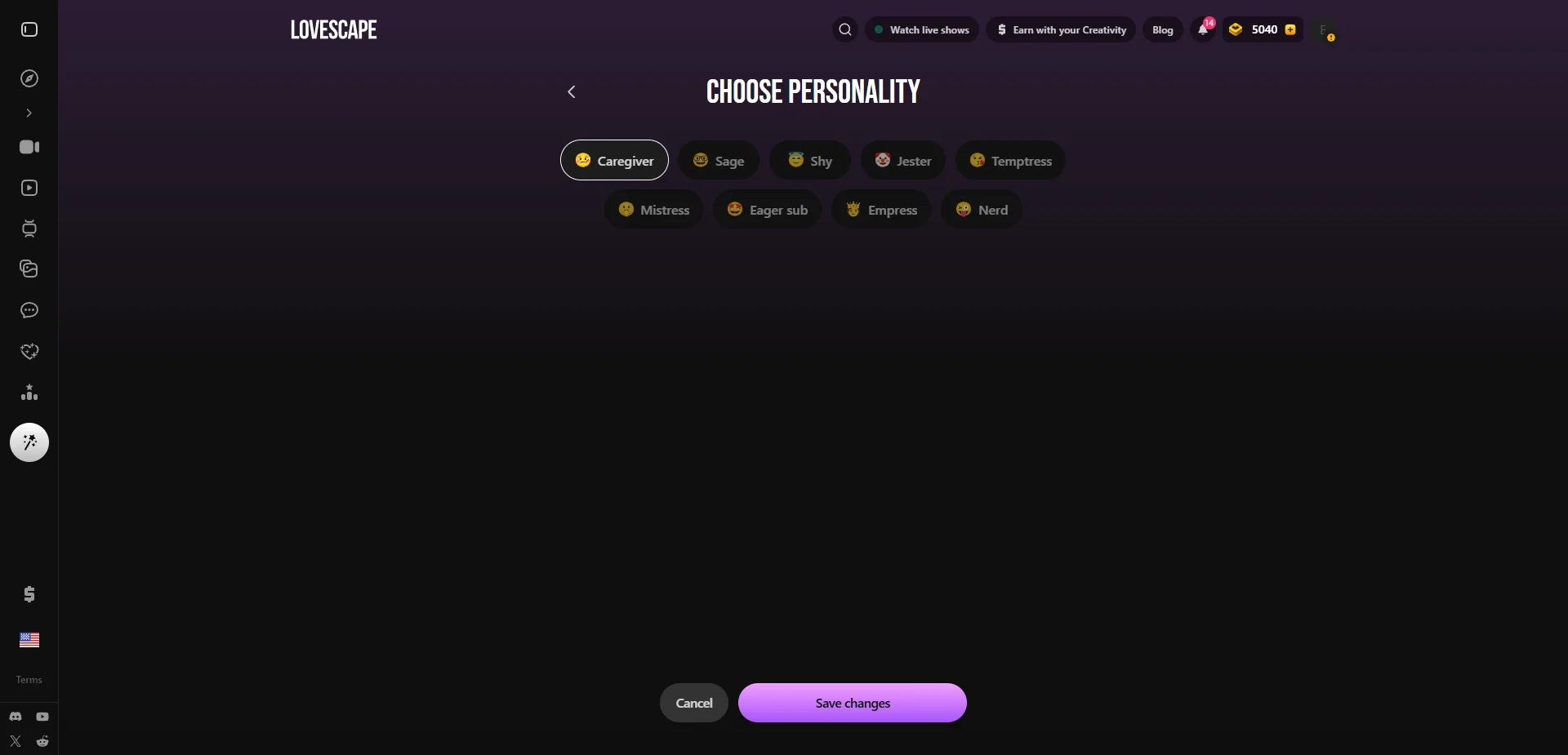
Lovescape starts in character creation, so the first thing you do is the thing that matters most.
Open Lovescape →18+ only · Cancel anytime
Keep reading
Which AI Companion Apps Require ID Verification in the US?
One of the three apps we cover asks for a video selfie, a document, or a third-party ID check before you can sign up from a US IP. The other two ask for nothing. What that split actually maps to, and what we still can't tell you.
9 min readGuideAI Waifu Apps in a Browser Tab: What 'No Install' Actually Costs You
None of our three live picks live in an app store — you open a link and you're talking to her in seconds. That convenience is real, and so is what it quietly costs once you're a week in.
9 min readGuideAI Waifu for Gamers: What Actually Fits Around Playing
Most companion advice assumes you have an evening. If your evening is already spoken for, the requirements change, and so does which app is right.
7 min readGuideAI Waifu Roleplay: How It Works, and Where It Breaks
Roleplay is the thing these apps are actually for, and it fails in predictable ways. What the model is really doing, why long scenes drift, and how to keep one sharp.
8 min read